
shopping cart ( )


The Importance of Heart Rate Monitor
Posted:
April 19, 2019
The Importance of Heart Rate Monitor
19 April 2019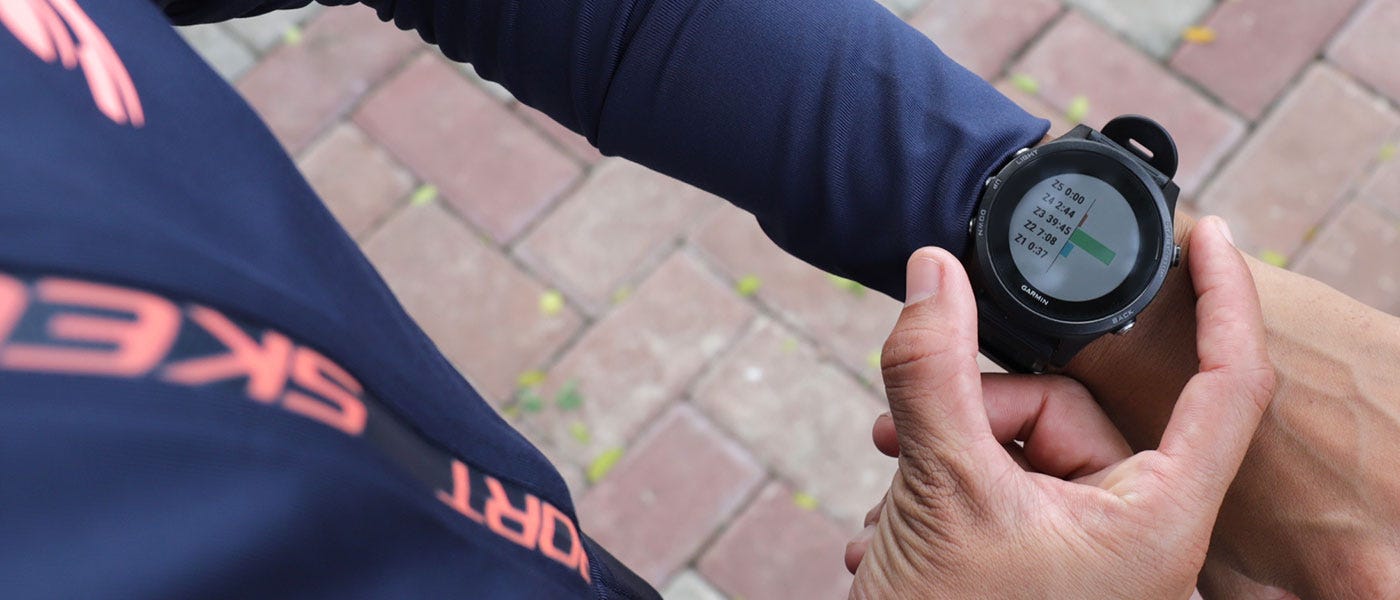
Reach your peak performance with training using 5 heart rate zones.
That GPS watch on your wrist, it’s not just an accessory. Besides showing pace, distance, running route, and amount of calories burnt, on many model, GPS watch can also shows heart rate and its zones. Training using heart rate monitor means training your cardiorespiratory system to work at a specific effort for a set amount of time.
4 Reasons Why You Need a Heart Rate Monitor
1/ Motivation
Using heart rate can make training more interesting. There are 5 different zones and you can switch up your workout routine from those 5 zones, preventing exercise from becoming a chore. This ultimately motivates you to keep at it long after you see the results.
2/ Train more efficiently
Whether your goal is to lose weight, improve your fitness or engage in productive activity while recovering from an injury, heart rate training pushes you to find the right balance. Keeping track of the heart rate monitor on your fitness tracker is a smart way to gauge whether each session is working for you, or if you need to make adjustments.
3/ Avoid injury
When your body is tired, there will often be big changes in your heart rate at rest and during exercise. By looking at your heart rate consistently, you can stop yourself from overtraining and becoming injured or ill.
4/ Burn calories
If you’re looking to lose weight, this is a perfect way to burn calories because it trains the body to burn fat more efficiently. You can work out the best heart rate zone you should be aiming for in order to lose the weight. And the HR will help you calculate more accurately how many calories your burn while training.
Prepare your training with a good pair of running shoes. Check our men’s running shoes collection and women’s running shoes collection.
5 HR Training Zones Explained
There are 5 different heart rate zones. They are all based off of your maximum heart rate. To find out your max heart rate, use this formula: 220 minus your age. E.g a 35 year old’s maximum heart rate is 220 minus 35 = 185.
Zone 1: 50-60% of your max heart rate.
This is very low intensity. Perfect for recovery.
Zone 2: 60%-70% of your Max Heart Rate
This zone is best for improving your endurance.
Zone 3: 70%-80% of your Max Heart Rate
This zone is especially effective for improving the efficiency of blood circulation in the heart and skeletal muscles.
Zone 4: 80%-90% of your Max Heart Rate
At this intensity, you will be improving your speed endurance and being able to withstand high amounts of lactic acid
Zone 5: 90%-100% of your Max Heart Rate
You can only continue at this intensity for a few minutes. Best not to go into this zone unless racing.
Whatever your training zone, wear our comfortable running apparel: men’s jersey, men’s short, women’s jersey, and women’s short.
Listen to Your Resting Heart Rate
A normal resting heart rate value for an adult ranges from 60-80. If you’re fit, your resting heart rate should be significantly lower than this.
Try and get into a consistent routine of taking your resting heart rate when you wake up. If your resting heart rate is elevated, try and work out the cause and get on top of the problem.
Possible Reasons:
1/ Overtraning
Your body could be in a state of overtraining due to too much training and too little recovery.
2/ Dehydrated
When dehydrated, your heart has to work significantly harder to provide enough oxygen and nutrients to the muscles.
3/ Stress
Mental and or physical stress causes your resting heart rate to increase, as your body is preparing for a fight or flight situation
4/ Emotion
If you’re excited or scared, your resting heart rate is much more likely to be elevated. For example, before a race.
80/20 Rule
As runner who likes long distance running, we need a good endurance. Unfortunately, most runners do too much training at high intensities. Whereas, the 80/20 rule states that 80% of your weekly training should be at lower intensities and 20% should be at high intensities.
Low intensity: Zone 1 and Zone 2.
Heart rate. 50-70% of max heart rate.
High intensity: Zone 3-5.
Heart rate: 70%-100% of max heart rate.
1/ It takes discipline and restraint to change to this type of training.
2/ After doing the 80/20 training type, you will notice that you just feel more comfortable in your low-intensity workouts. Perhaps you enjoy them more.
3/ Then you will discover that you feel fresher for your harder workouts and perform better in them.
4/ Next, you will experience accelerated fitness development.
5/ And finally you will achieve a performance breakthrough in your next race. By then, you will be completely sold and forever hooked on 80/20 training.
Train Your Peak Heart Rate
If you’re looking to run a fast 5,000 m or a race of shorter distance, you will need to train your peak heart rate.
What?
-Your peak heart rate is from 95-100% of your max heart rate.
-This type of training should be done in the weeks prior to your main race.
Why?
-This type of training is needed to make your anaerobic energy system more efficient.
-It teaches your body to maintain a high pace towards the end of the race, where you have accumulated a large amount of lactic acid.
-In a 5km race, 75% of your energy is aerobic, while the other 25% comes from anaerobic energy. It means if you do not train your anaerobic system by training near your max heart rate, you will not achieve your maximum potential time in a 5km race.
Important points:
-Check with your doctor first to ensure it is safe to push your heart rate to high level.
-Avoid reaching your peak heart rate more than once a week. It is very taxing on the body.
-After a peak heart rate session, the following day must be a recovery run.
Sample session:
-12 x 400 m with 200 m jog, holding peak heart rate about 95%
-During your 200 m jog make sure your heart rate drops below 65%. If you aren’t recovering in time, slow your 400 m reps down.
Don’t forget to drink after training. Check our sport water bottle collection
Using Heart Rate Monitor for Long Run
Long run is normally completed once a week by endurance runners to build their aerobic base. Long run also teaches your body to mainly use fat as a fuel for the run. Our bodies have almost limitless supplies of fat for fuel, but our carbohydrate supplies are very limited.
What heart rate should the long runs be completed at?
Long run should be run at 55-70% of your max heart rate (or zone 2). It is important to not go into zone 3.
Note: The difference between the recovery run and the long run is only the length of time you are on your feet. For beginners, a long run should be double your recovery run. For experienced runners, is about three times the length of your recovery run. So I suggest 30 mins for an easy recovery run in and 90 mins for a long run; both in zone 1 & 2.
How do you increase the difficulty of a long run?
To increase the difficulty of a long run, keep the heart rate in zone 2, but increase the distance. By holding yourself back and keeping it easier, you will also be able to go further.
Note: As you get fitter, the pace you go while running at the same heart rate will increase. If your heart rate remains constant but over time you start running slightly faster, this means you are getting fitter. You will need a smart watch with GPS and HR to monitor this.
Using Heart Rate Monitor for Recovery Run
The aim of a recovery run is to flush out the lactic acid from the body and allow your body to repair itself, while building up your aerobic base. If you run at too high an intensity (or too high a heart rate), this will impede your recovery.
Recovery runs should be completed in zone 1& 2 that is 50-65 % of your max heart rate. It is vital to not go into zone 3 where you start to accumulate lactic acid. Accumulating lactic acid will inhibit the development of your aerobic system.
You should be able to hold a full conversation during your recovery run. It’s important to have discipline. You can never go too easy on a recovery run, but you can easily go too hard if you don’t have a heart rate monitor.
The Golden Rule is, if you can’t breath through your nose while running, slow down until you can, because you are going too fast.
Don’t forget to follow us on Planet Sports Run Instagram